CLM Implementation Roadmap: From Spreadsheets to Smart Contracts
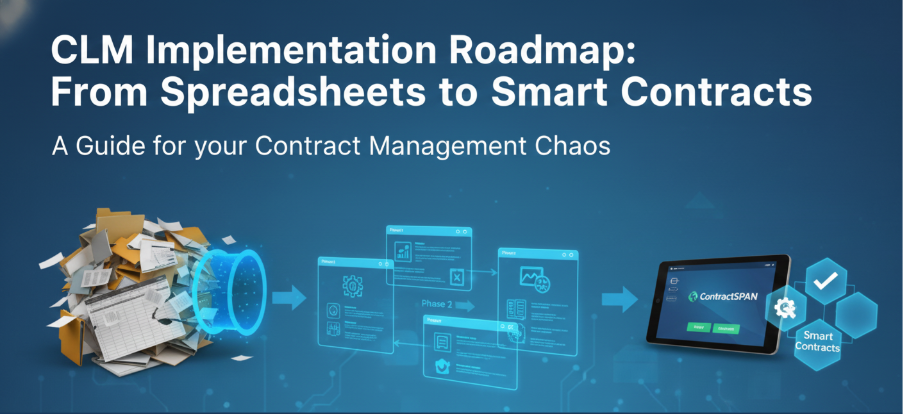
A Guide for your Contract Management chaos
The spreadsheet era of contract management is fading. Companies storing critical agreements across scattered Excel files, manual approval chains, and email threads leave significant value on the table—up to 40%, according to research. Yet the jump from legacy systems to modern contract lifecycle management (CLM) solutions feels daunting for many organizations.
This roadmap covers essential phases of CLM implementation, from recognizing your current state to embracing intelligent automation and future-ready technologies like smart contracts.
Spreadsheets create operational blind spots: duplicate data, version control nightmares, no visibility into contract timelines, missed renewals, and scattered information preventing informed decisions. This inefficiency introduces compliance risks and potential penalties.
Organizations relying heavily on manual contract processes lose nearly 2% of revenue annually through poor governance. Automated CLM can reclaim this value.
Essential CLM Implementation Phases
Phase 1: Map Your Current State
Honest assessment is critical. Document contract request origins, approval flows, phase durations, bottlenecks, and current data storage systems. Legal teams often spend 30-40% of their time on administrative tasks, an opportunity for automation.
Phase 2: Define Business Objectives
Tie your CLM implementation to measurable outcomes like:
- Cutting contract cycle times by 40-60%
- Achieving 95%+ compliance rates
- Enhancing contract visibility with real-time dashboards
- Minimizing revenue leakage via automated renewal alerts
- Reducing administrative costs with AI-powered automation
Companies achieve 2.3x faster contract cycles, in some cases halving execution times from 33 to 14 days, transforming business performance.
Phase 3: Establish Your Implementation Foundation
Form a cross-functional team including legal, procurement, sales, finance, and IT. This fosters collaboration and ensures the system meets diverse organizational needs, preventing silos.
Phase 4: Build Standardized Templates and Clause Libraries
Create standardized contract templates for common types like MSAs, NDAs, employment, and supplier agreements. Develop clause libraries organized by risk and business function, with alternative language options. This accelerates contract creation while reducing legal risk.
Phase 5: Implement Core CLM Functionality
Modern CLM automates:
- Contract creation from templates
- Real-time negotiation and redline collaboration
- Intelligent review and approval routing with AI risk detection
- Digital signatures with audit trails
- Obligation tracking and dashboard alerts
- Renewal intelligence preventing missed deadlines
Phase 6: Integrate Your Business Ecosystem
Integrate the CLM platform with ERP, CRM, procurement, and HR systems. This eliminates manual data entry, reduces errors, and enhances business visibility, connecting contracts seamlessly to financial and operational processes.
Phase 7: Migration and Data Strategy
Prioritize migration of high-value active contracts. Use AI to extract metadata for parties, dates, payment terms, and renewal clauses. Migration often uncovers consolidation and renegotiation opportunities.
ContractSPAN CLM Implementation Roadmap
1. Assess Current Contract Management Processes
- Map out existing workflows, including contract request sources, approval bottlenecks, and storage systems.
- Identify manual pain points, operational inefficiencies, and compliance risks with spreadsheet-based management.
2. Define Clear Business Objectives
- Establish measurable goals such as accelerating contract cycle times, improving compliance rates, and reducing administrative costs.
- Align objectives with organizational strategy to maximize value from CLM.
3. Assemble Cross-Functional Implementation Team
- Include legal, procurement, sales, finance, and IT stakeholders.
- Foster collaboration to ensure ContractSPAN CLM addresses needs across departments.
4. Standardize Contract Templates and Clause Libraries
- Build a centralized library of templates and clauses in ContractSPAN for commonly used contracts (NDAs, MSAs, employment agreements).
- Enable consistency and faster contract creation with customizable, risk-aligned clause options.
5. Deploy Core ContractSPAN CLM Features
- Automate contract generation and authoring from templates.
- Use ContractSPAN's AI-powered risk detection and clause analysis during negotiation and review.
- Streamline approvals with intelligent routing workflows.
- Accelerate execution with integrated digital signatures and audit trails.
- Employ obligation and renewal tracking dashboards for proactive management.
6. Integrate ContractSPAN with Existing Systems
- Connect ContractSPAN CLM with ERP, CRM, procurement, and HR platforms to synchronize contract data comprehensively.
- Eliminate manual data entry and reconcile contracts with business operations.
7. Migrate Legacy Contracts with AI Assistance
- Use ContractSPAN's AI-powered contract extraction to import key metadata from legacy spreadsheets and documents.
- Prioritize high-value contracts for migration to enable immediate benefits.
8. Expand Towards Smart Contracts
- Begin integrating smart contract capabilities for self-executing agreements where suitable.
- Combine ContractSPAN's legal-grade AI with blockchain-enabled contract execution for automated payments, compliance, and supply chain transparency.
9. Monitor Performance and Continuously Improve
- Track KPIs like cycle times, compliance rates, contract volume, and user adoption within ContractSPAN.
- Use actionable insights to refine templates, workflows, and AI configurations.
The Smart Contract Evolution: Beyond CLM Automation
Smart contracts are self-executing agreements on blockchain networks, automating payments, compliance, supply chain transparency, and real-time settlements without manual intervention.
Smart contracts extend rather than replace traditional CLM: handling standardized, high-volume agreements while the CLM platform manages complex negotiations and relationships.
Measuring Your Implementation Success Track:
- Contract cycle time reduction
- User adoption rates
- Compliance improvements
- Administrative time savings
- Revenue impact from faster deal closure
- Risk reduction through standardized processes
Organizations often realize 10-20% personnel cost reductions and accelerated revenue cycles.
Your Path Forward
From spreadsheets to smart contracts, CLM implementation is a transformative journey. Start with assessment, define clear goals, assemble cross-functional teams, build templates, choose fitting technology, and plan for continuous improvement.
Platforms like ContractSPAN exemplify CLM systems that help organizations visualize contract portfolios, automate risk detection, and streamline approvals—enabling a smooth transition without disruption.
Looking to transform your contracts? Then you're at the right place. Book your Demo call now.
Naina Malviya
December 09, 2025